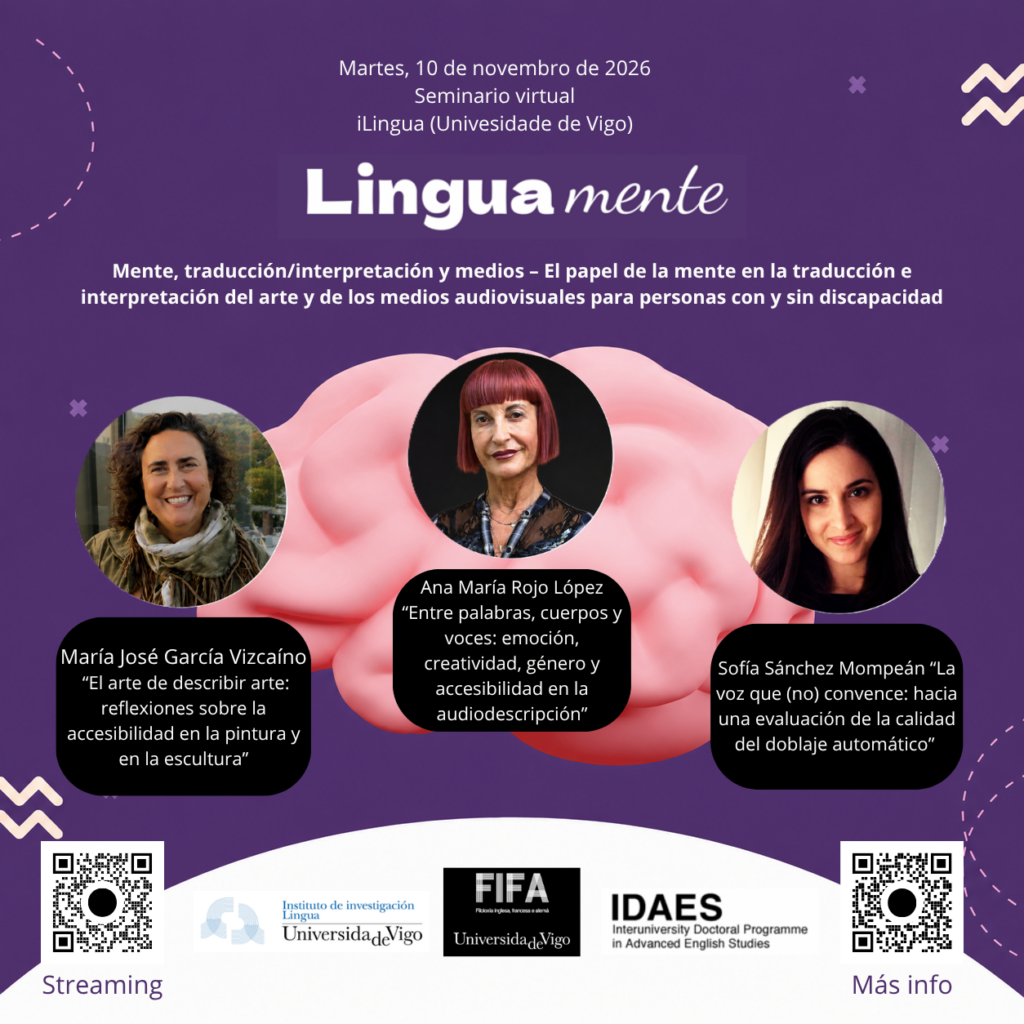
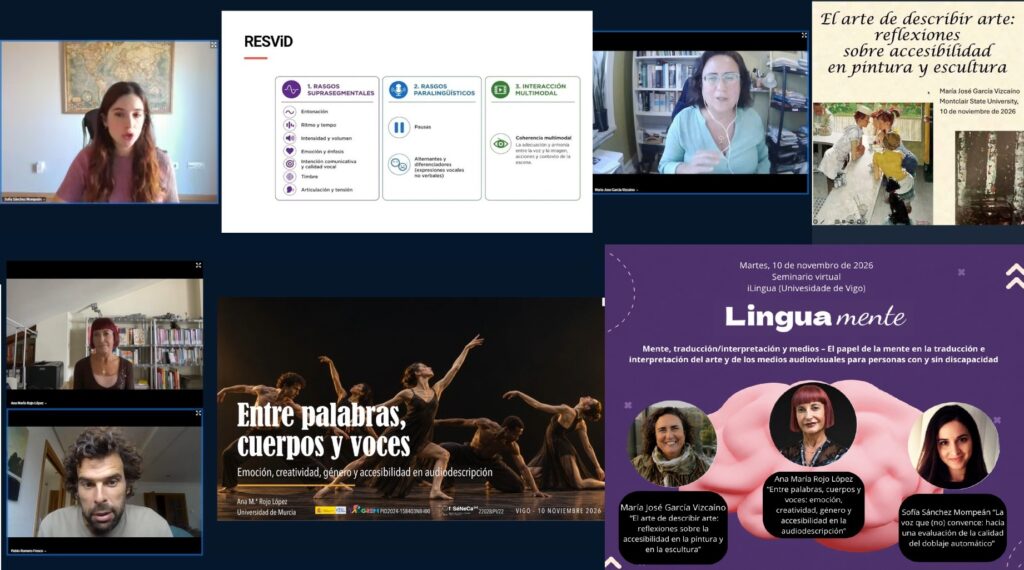
November 10, 2026. The Lingua Research Institute (iLingua) at the University of Vigo organized another edition of Linguamente, an online scientific conference dedicated to exploring the connections between language, languages, and cognition from linguistic, social, neurological, and cognitive perspectives. On this occasion, Linguamente2026 addressed the challenges of automatic dubbing, audio description, and access to culture for people with and without disabilities. Under the title “Mind, Translation, and Interpretation in the Media: The Role of the Mind in the Translation and Interpretation of Art and Audiovisual Media for People with and without Disabilities,” the event, coordinated by Pablo Romero Fresco, professor of Translation and Interpretation and a researcher at iLingua, could be followed live via the University of Vigo’s streaming platform.
Linguamente2026 focused on how mental processes, emotions, creativity, and perception influence the translation and interpretation of artistic and audiovisual content. Through three lectures and a roundtable discussion, the event addressed issues of particular relevance in a context marked by the development of automated voice and video generation technologies and by the need to move toward a more accessible and inclusive culture. The first presentation was given by Sofía Sánchez Mompeán, a professor in the Department of Translation and Interpretation at the University of Murcia, with the lecture “The Voice That (Does Not) Convince: Toward an Evaluation of the Quality of Automatic Dubbing.” A specialist in audiovisual translation and prosody, Sánchez Mompeán focused her presentation on the challenges posed by evaluating the automated voices used in dubbing and the media. The second lecture, “Between Words, Bodies, and Voices: Emotion, Creativity, Gender, and Accessibility in Audio Description,” delivered by Ana María Rojo López, professor of Translation and Interpretation at the University of Murcia, explored the relationship between cognitive processes, emotions, and creativity in audio description. Rojo López directs the Translation, Didactics, and Cognition research group in Murcia and has extensive experience studying the individual and emotional factors involved in translation processes. The third lecture was delivered by María José García Vizcaíno, a professor at Montclair State University (U.S.). Under the title “The Art of Describing Art: Reflections on Accessibility in Painting and Sculpture,” Professor García Vizcaíno highlighted the challenge of making works of art accessible to people with visual impairments. Specializing in audio description and tactile accessibility in art museums, García Vizcaíno also develops projects that bring the performing arts and the visual arts to Spanish-speaking audiences with low vision. The event concluded with a roundtable discussion moderated by Pablo Romero on the content of the previous presentations, featuring questions posed by both the event coordinator and the online audience.
Linguamente2026 will be available shortly through the iLingua repository on UVigoTV at https://ilingua.tv.uvigo.es/. The event was funded by iLingua itself, the Department of English, French, and German Philology, and the doctoral program in Advanced English Studies (IDAES) at the University of Vigo.
All the information on Linguamente 2026